
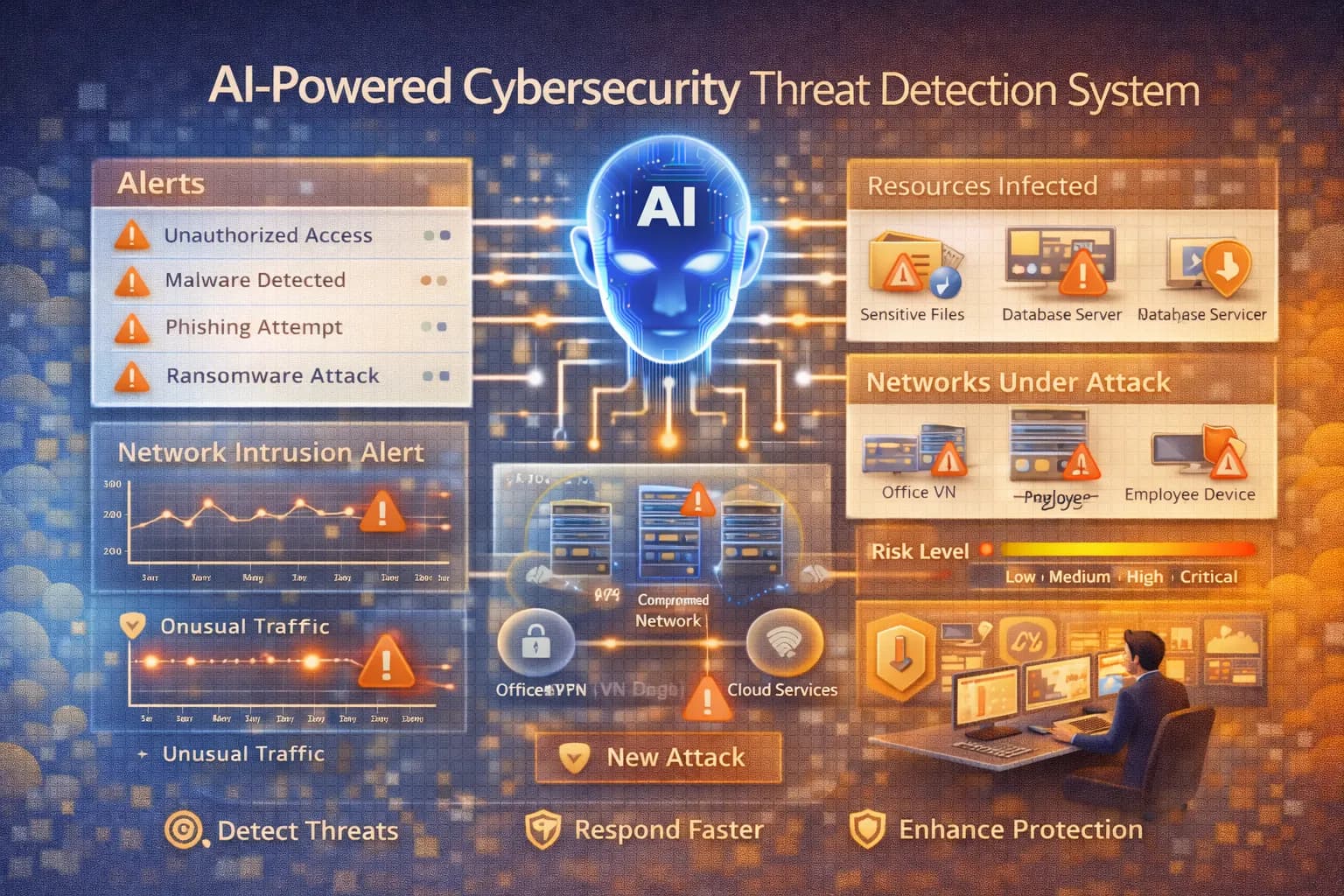
AI in Cybersecurity: Detecting Threats Before They Happen
Md Sharif Foysal Shoron
Author
Cybersecurity has become one of the most critical challenges for modern businesses. As organizations adopt cloud platforms, SaaS applications, remote work models, and interconnected systems, the attack surface expands dramatically. Traditional security tools, which rely heavily on predefined rules and signature-based detection, struggle to keep up with the speed, scale, and sophistication of modern cyber threats.
Artificial intelligence introduces a fundamentally different approach to cybersecurity. Instead of reacting to known attack patterns, AI systems analyze behavior, detect anomalies, and identify potential threats before damage occurs. This shift from reactive defense to proactive detection is transforming how businesses protect their digital assets.
The Limitations of Traditional Cybersecurity Approaches
Traditional cybersecurity systems depend on static rules, signature databases, and manual configuration. While effective against known threats, these systems are poorly equipped to detect new or evolving attack techniques.
Attackers continuously modify malware, exploit zero-day vulnerabilities, and use social engineering tactics that bypass rule-based defenses. As a result, security teams often discover breaches only after significant damage has already occurred.
Manual monitoring further compounds the problem. Security teams must sift through massive volumes of logs, alerts, and signals, making it difficult to identify genuine threats in real time.
How AI Changes the Cybersecurity Landscape
AI-powered cybersecurity systems do not rely solely on predefined rules. Instead, they learn what normal behavior looks like across users, devices, networks, and applications. Any deviation from this baseline is flagged for further analysis.
Machine learning models continuously adapt as systems evolve, enabling detection of previously unseen threats. This adaptive capability makes AI particularly effective against advanced persistent threats and insider risks.
Anomaly Detection as the Core of AI Security
Anomaly detection is central to AI-driven cybersecurity. By analyzing network traffic, login behavior, data access patterns, and system activity, AI identifies subtle deviations that may indicate malicious intent.
For example, an AI system may detect unusual login times, abnormal data transfers, or unexpected privilege escalation. These indicators often appear long before a full-scale attack is launched.
Key Use Cases of AI in Cybersecurity
One of the most common applications of AI in cybersecurity is intrusion detection. AI systems monitor network traffic to identify suspicious activity that bypasses traditional firewalls.
AI is also widely used in fraud detection, identifying unauthorized transactions or account takeovers by analyzing behavioral patterns. In endpoint security, AI detects malware by examining execution behavior rather than relying on known signatures.
Email security platforms use AI to identify phishing attempts by analyzing language patterns, sender behavior, and contextual signals. These systems adapt quickly as attackers change tactics.
Reducing False Positives and Alert Fatigue
One major challenge in cybersecurity is alert fatigue. Traditional systems generate excessive alerts, overwhelming security teams and increasing the risk of missed threats.
AI reduces false positives by learning which anomalies are benign and which represent real risks. Over time, models become more precise, allowing teams to focus on high-impact incidents.
Integrating AI Security into Backend Systems
AI cybersecurity solutions must integrate seamlessly with existing systems. Backend platforms like Django enable secure API connections, event logging, and access control that support AI-driven monitoring.
Centralized logging and audit trails ensure AI insights can be investigated and acted upon quickly.
Human Oversight and Incident Response
AI enhances cybersecurity, but it does not replace human expertise. Security teams remain responsible for interpreting alerts, investigating incidents, and making strategic decisions.
The most effective security systems combine AI-driven detection with well-defined incident response workflows.
The Business Value of AI-Driven Cybersecurity
AI-powered cybersecurity reduces breach impact, minimizes downtime, and protects customer trust. Proactive detection lowers long-term costs and improves regulatory compliance.
How Square Tech IT Builds AI Security Solutions
At Square Tech IT, we design AI-driven cybersecurity systems that integrate deeply with backend architecture. Our solutions focus on early detection, reduced false positives, and actionable intelligence that helps businesses stay ahead of emerging threats.