
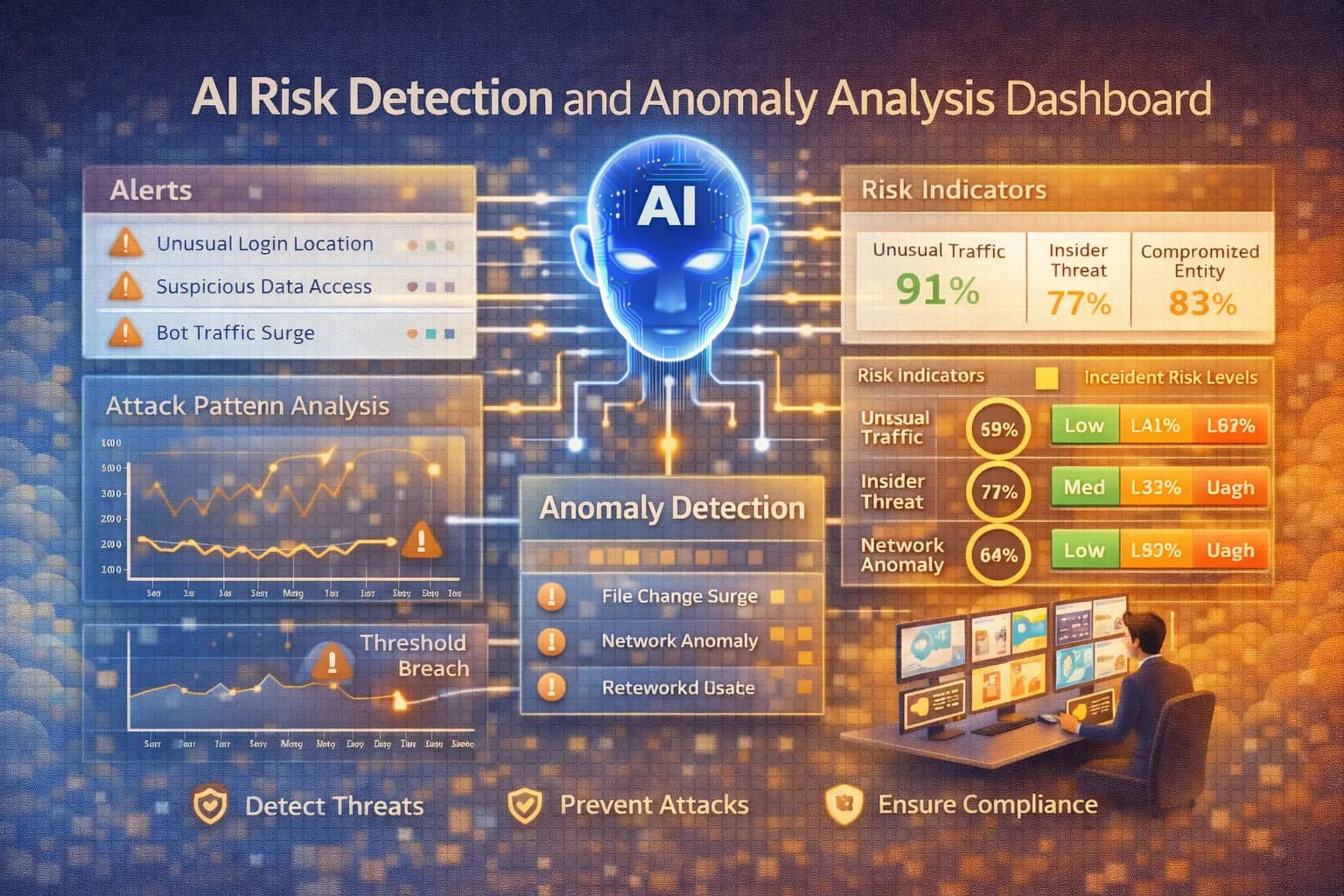
AI for Risk Detection and Anomaly Analysis
Md Sharif Foysal Shoron
Author
Risk detection has traditionally relied on predefined rules and thresholds. While effective for known issues, these methods struggle to identify new or subtle threats. As systems grow more complex and data volumes increase, manual monitoring becomes inefficient and error-prone.
Artificial intelligence enables a more advanced approach to risk detection by identifying anomalies that deviate from normal patterns. Instead of relying solely on static rules, AI systems learn what “normal” looks like and flag unexpected behavior automatically.
Understanding Anomaly Detection
Anomaly detection refers to identifying data points, behaviors, or events that differ significantly from expected patterns. These anomalies may indicate fraud, system failures, security breaches, or operational issues.
AI models analyze historical data to establish baselines. When new data deviates from these baselines, the system generates alerts for investigation. This approach allows businesses to detect unknown risks rather than only known threats.
Why Traditional Rule-Based Systems Fall Short
Rule-based systems depend on predefined conditions. They only detect issues that have already been anticipated. When new attack methods or failures emerge, rule-based systems often miss them entirely.
AI-driven anomaly detection adapts continuously. As patterns evolve, the system updates its understanding, reducing false positives and improving detection accuracy over time.
Common Use Cases for AI Risk Detection
In cybersecurity, AI detects unusual login behavior, abnormal traffic patterns, and suspicious activity that may indicate breaches. These systems identify threats early, reducing damage and response time.
Financial institutions use anomaly detection to identify fraud, money laundering, and unauthorized transactions. AI models analyze transaction behavior across millions of records to spot subtle irregularities.
Operational systems apply anomaly detection to monitor infrastructure, detect failures, and prevent downtime. Manufacturing and logistics companies use AI to identify equipment anomalies before breakdowns occur.
Data and Model Requirements
Accurate anomaly detection requires large, representative datasets that reflect normal behavior. AI models must be trained on clean data to avoid misclassifying legitimate activity as risk.
Backend platforms like Django support these systems by enforcing data validation, managing secure APIs, and enabling scalable data ingestion.
Balancing Sensitivity and False Positives
One challenge in anomaly detection is balancing sensitivity with accuracy. Overly sensitive systems generate excessive alerts, overwhelming teams. Insensitive systems miss real threats.
AI models must be tuned carefully and reviewed regularly to maintain the right balance.
Human Review and Incident Response
AI systems identify risks, but human expertise is required to interpret and respond appropriately. Clear escalation workflows ensure anomalies are handled efficiently.
Long-Term Value of AI Risk Detection
AI-driven risk detection reduces losses, improves security posture, and increases operational resilience. Over time, these systems become more accurate and cost-effective.
How Square Tech IT Builds Risk Detection Systems
At Square Tech IT, we design AI-powered risk detection and anomaly analysis systems that integrate seamlessly with business operations. Our solutions focus on accuracy, scalability, and actionable insights that help organizations stay ahead of emerging risks.