
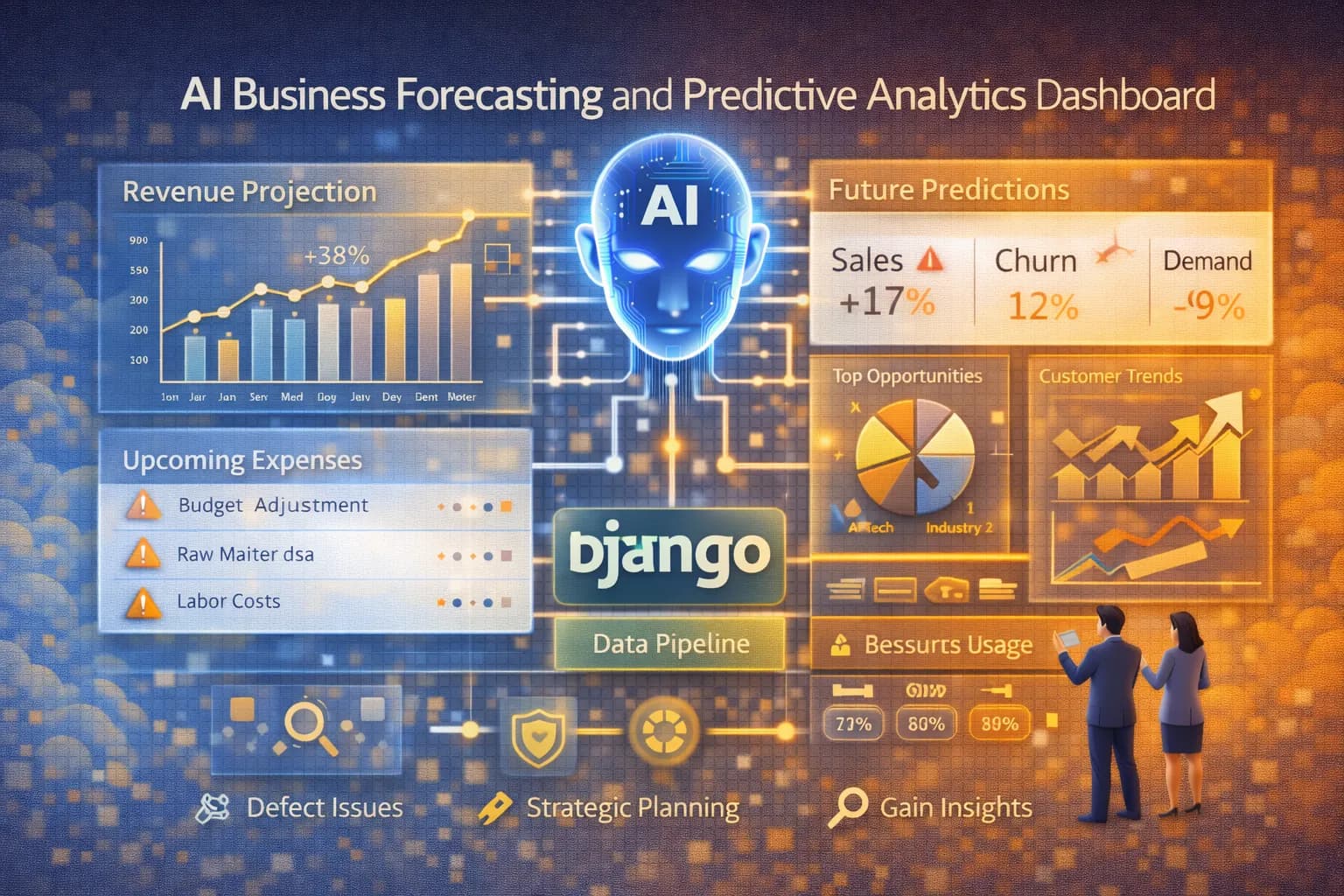
Using AI for Business Forecasting and Predictive Analytics
Md Sharif Foysal Shoron
Author
Business forecasting has always been a critical component of strategic decision-making. Organizations rely on forecasts to plan inventory, allocate resources, manage budgets, and anticipate market demand. Traditionally, forecasting depended heavily on historical averages, static models, and human intuition. While these approaches provided some value, they struggled to keep pace with rapidly changing markets and complex data environments.
Artificial intelligence fundamentally changes how forecasting and predictive analytics are performed. AI-driven forecasting systems analyze large volumes of historical and real-time data, identify hidden patterns, and continuously adapt to new information. This allows businesses to move from reactive planning to proactive and predictive decision-making.
The Difference Between Traditional Forecasting and AI Forecasting
Traditional forecasting methods rely on fixed formulas and assumptions. These models often assume stable patterns, linear growth, and limited external influence. While effective in predictable environments, they fail when conditions shift suddenly due to economic changes, customer behavior, or external disruptions.
AI-based forecasting models do not rely on rigid assumptions. Instead, they learn directly from data. Machine learning algorithms analyze historical trends, seasonal behavior, anomalies, and correlations that humans may overlook. As new data becomes available, these models automatically update their predictions without requiring manual recalibration.
This adaptability makes AI forecasting particularly valuable in dynamic industries such as e-commerce, finance, logistics, healthcare, and SaaS, where demand and usage patterns change rapidly.
How Predictive Analytics Works in Practice
Predictive analytics uses AI models to estimate future outcomes based on historical and current data. These models examine relationships between variables and calculate the likelihood of specific events occurring.
For example, a predictive analytics system may forecast customer churn by analyzing usage behavior, support interactions, billing history, and engagement trends. Instead of guessing which customers may leave, businesses receive data-backed probability scores that enable targeted intervention.
Predictive analytics also supports financial forecasting, demand planning, workforce optimization, and risk assessment. By quantifying uncertainty, businesses gain a clearer understanding of potential outcomes rather than relying on best-guess scenarios.
Key Business Use Cases for AI Forecasting
One of the most common use cases for AI forecasting is demand prediction. Retailers and manufacturers use AI to estimate future sales volumes across regions, product categories, and time periods. This reduces overstocking, prevents shortages, and improves supply chain efficiency.
In financial planning, AI helps forecast revenue, cash flow, and expenses with higher accuracy. Predictive models consider seasonality, customer behavior, and macroeconomic indicators, allowing finance teams to plan with greater confidence.
AI forecasting is also widely used in risk management. Financial institutions apply predictive analytics to assess credit risk, detect fraud, and anticipate defaults. Operations teams use forecasting to predict system failures, downtime, or maintenance needs before issues occur.
Data Requirements for Accurate Forecasting
High-quality data is the foundation of effective AI forecasting. Models require clean, consistent, and representative datasets to generate reliable predictions. Incomplete or biased data leads to inaccurate forecasts and poor decision-making.
Businesses must ensure proper data collection, validation, and preprocessing before deploying predictive models. Backend systems such as Django play a crucial role by enforcing validation rules, managing data pipelines, and ensuring data integrity.
Integrating Forecasting into Business Workflows
Forecasting insights deliver the most value when integrated directly into operational workflows. Predictions should be accessible through dashboards, reports, and automated alerts that support real-time decision-making.
Instead of static reports, AI-driven systems provide continuous forecasts that evolve as conditions change. This enables teams to adjust plans dynamically rather than reacting after outcomes occur.
Challenges and Limitations of AI Forecasting
While powerful, AI forecasting is not infallible. Models depend on historical patterns, which may break during unprecedented events. Human oversight remains essential for interpreting predictions and handling edge cases.
Businesses should treat AI forecasts as decision-support tools rather than absolute truth. Combining predictive insights with domain expertise results in the best outcomes.
How Square Tech IT Delivers AI Forecasting Solutions
At Square Tech IT, we build AI-powered forecasting and predictive analytics systems that align with real business objectives. Our solutions combine robust data pipelines, scalable backend architecture, and interpretable AI models to help businesses plan confidently and reduce uncertainty.